Analytical Services

Gideon Analytical provides a variety of techniques which allow us to be the most advanced failure analysis house with electrical components, printed circuit boards, materials, quality control, vendor inspection, and understanding component processes. We design, debug and review electrical schematics, in addition to matching the failure with a design, application, process, manufacturing, or environmental issue. We have over 35 years experience in this area.

Success Stories

Avago Optocoupler HCPL-2202 Failure Analysis

Avago Optocoupler HCPL-2202 Failure Analysis

Gideon Analytical Laboratories received several Avago HCPL-2202 Optocouplers for failure analysis. These optocouplers have a totem pole output stages and optical receiver input stages with built-in Schmitt triggers to provide logic-compatible waveforms. They feature low input current (1.6mA to 1.8mA), Mbd typical signal rate, and guaranteed performance from -40 to 85 degrees Celsius. Some of their applications include isolation of high-speed logic systems, microprocessor system interfaces, and ground loop elimination. Our goal was to determine why the Avago HCPL-2202 Octocouplers had been failing.

Failed Cortina WJLXT971ALCA4e3 IC on PCB

Failed Cortina WJLXT971ALCA4e3 IC on PCB

Gideon Analytical Laboratories received 20 failed Cortina WJLXT971ALCA4e3 Ethernet ICs to analyze. Integrated Circuits (ICs) are a set of electronic circuits on one small flat piece (or “chip”) of semiconductor material that is normally silicon. The integration of large numbers of tiny transistors into a small chip results in circuits that are orders of magnitude smaller, faster, and less expensive than those constructed of discrete electronic components. These Cortina WJLXT971ALCA4e3 ICs were suspected to be possibly mislabeled or have some kind of manufacturing defects. The goal was to determine why these Cortina WJLXT971ALCA4e3 Ethernet ICs were failing.

Failure Analysis of TI TPS767D301 Voltage Regulator

Failure Analysis of TI TPS767D301 Voltage Regulator

Gideon Analytical Laboratories received one TI TPS767D301 dual-output low-dropout voltage regulator with a ground to reset short The TI TPS767D301 offers a transient response, low dropout voltages, and dual outputs. It is designed primarily for DSP applications. It features extended temperature performance from 55 to 125 degrees Celsius, drop out voltage typically 350 mV at 1 A, and enhanced product-change notification. The goal was to determine why these TI TPS767D301 voltage regulators were failing, paying special attention to the ground to reset short.

Failure Analysis on RY4S-UAC110-120V Power Relay

Failure Analysis on RY4S-UAC110-120V Power Relay

Gideon Analytical Laboratories received several RY4S-UAC110-120V power relays for failure analysis. A relay is an electrically operated switch. Many relays use an electromagnet to operate the switch, but other operating principles are also used, such as solid-state relays. Relays are used where it is necessary to control a circuit by a separate low-power signal, or where several circuits must be controlled by one signal. Relays are used to control a high power or high voltage circuit with a low power circuit. The low power is isolated from the high power circuit. The RY4S-UAC110-120V power relays have 4PDT contact configuration, 5A contact current, quick connect relay terminals, and silver contact material. Their coil resistance is 4.29kohm. When given the RY4S-UAC110-120V power relays, we were to tasked with determining the stuck core/contact cause.

Failure Analysis on TI TMS320F28335PGFA DSP

Failure Analysis on TI TMS320F28335PGFA DSP

Gideon Analytical Laboratories received a TI TMS320F28335PGFA Digital Signal Processor for failure analysis. Digital Signal Processing applications include audio and speech processing,sonar,radar, and other sensor array processing,spectral density estimation,statistical signal processing,digital image processing, among many others. The TI TMS320F28335PGFA features high-performance static CMOS technology, a 32-bit CPU, 16 x 16 and 32 x 32 MAC operations, and Harvard bus architecture. It has up to 88 individually programmable, multiplexed GPIO pins with input filtering. We were advised to pay special attention to pins 141 and 148 because they were possibly nonfunctional in operation.

Stackpole 100-ohm Power Resister Failure Analysis

Stackpole 100-ohm Power Resister Failure Analysis

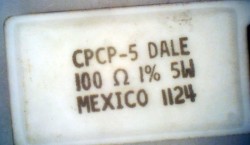
Gideon Analytical Laboratories received three different vendor 100-ohm resistors, made by Vishay, RCD, and Stackpole, respectively. The two Stackpole resistors were open. A resistoris a passive two-terminal electrical component that implements electrical resistance as a circuit element. In electronic circuits, resistors are used to reduce current flow, adjust signal levels, to divide voltages, bias active elements, and terminate transmission lines, among other uses. Our goal was to test the functionality the Vishay, RCD, and Stackpole resistors, and if any were failing, determine the cause of the failure.

T491D475K050AT Kemet Tantalum Capacitor Analysis

T491D475K050AT Kemet Tantalum Capacitor Analysis

Gideon Analytical Laboratories received several T491D475K050AT Kemet tantalum capacitors for electronic failure analysis. A capacitor is a passive two-terminal electronic component that stores electrical energy in an electric field. While some capacitance exists between any two electrical conductors in proximity in a circuit, a capacitor is a component designed to add capacitance to a circuit. The Kemet T491D475K050AT has a capacitance of 4.7 uF, a voltage rating of 50 VDC, and a tolerance of 10%, measures 7.3mm x 4.3mm x 3.1mm (LWH), has a minimum operating temperature of -55 degrees Celsius and a maximum operating temperature of 125 degrees Celsius. One of these capacitors had already been tested and found to be a dead short. The other capacitors were to be used to determine whether acid had affected the forming voltage oxide.

Failure Analysis on 1N645 Silicon Rectifier Diodes

Failure Analysis on 1N645 Silicon Rectifier Diodes

Gideon Analytical Laboratories received two 1N645 silicon rectifier diodes for failure analysis. One was bad and the other was a quality diode to be used for comparison. A rectifier is an electrical device that converts alternating current(AC), which periodically reverses direction, to direct current(DC), which flows in only one direction. Rectifiers are used inside the power supplies of virtually all electronic equipment. AC/DC power supplies may be broadly divided into linear power supplies ands witched-mode power supplies. The 1N645 silicon rectifier diode has 225V 400mA ratings. It can handle a maximum of 5 Amps surge current and at 25 Degrees Celsius has an average maximum rectified current of 0.4 Amps. The goal was to determine why these diodes were failing.

Failure Analysis on Murata GCM21BR70J106KE22L MLCCs

Failure Analysis on Murata GCM21BR70J106KE22L MLCCs

Gideon Analytical Laboratories received several Murata Electronics GCM21BR70J106KE22L Multi-Layered Ceramic Capacitors (MLCCs) for failure analysis. An MLCC consists of a number of individual capacitors stacked together in parallel and contacted via the terminal surfaces. The starting material for all MLCC chips is a mixture of finely ground granules of paraelectric or ferroelectric raw materials, modified by accurately determined additives. The Murata Electronics GCM21BR70J106KE22L has a capacitance of 10 uF, a DC voltage rating of 6.3 VDC, has an XR7 dielectric, and has an SMD/SMT termination style. It has a minimum operating temperature of -55 Celsius and a maximum operating temperature of 125 Celsius. The goal was to determine why these MLCCs were failing, and while we did discover why, that is not the only thing we uncovered.

On Semiconductor SS16 Schottky Rectifier

On Semiconductor SS16 Schottky Rectifier

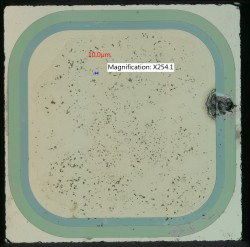
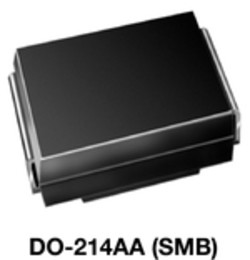
Gideon Analytical Laboratories received two On Semiconductor SS16 rectifier for failure analysis. The On Semiconductor SS16 Schottky Rectifier features glass-passivated junctions and a high-current capacity. Their applications include low voltage, high-frequency inverters, freewheeling, and polarity protection. Their storage temperature range is between -65 and 150 Degrees Celsius and the operating junction temperature is between -65 and 125 Degrees Celsius. Along with the two failed rectifiers, several good devices were also supplied for comparison. The goal was to determine why the On Semiconductor SS16 Schottky rectifiers were failing.

Vishay CRCW2512220RJNEG Thick Film Chip Resistors

Vishay CRCW2512220RJNEG Thick Film Chip Resistors

Gideon Analytical Laboratories received four Vishay CRCW2512220RJNEG thick film chip resistors to be analyzed. Thick film resistors are the most used resistors in electrical and electronic devices. The resistive material is a special paste with a mixture of a binder, a carrier, and the metal oxides to be deposited. These Vishay CRCW2512220RJNEG resistors thick film chip resistors feature stability at different environmental conditions and 2mm pitch packaging option for 0603 sizes. Typical applications for these chip resistors include automotive, telecommunications, and industrial. Its resistance range is 1 and 10 ohms. All of the Vishay CRCW2512220RJNEG thick film chip resistors tested open. The goal was to try to diagnose these failures.

Acrylic Film Capacitor Failures

Acrylic Film Capacitor Failures

Gideon Analytical Laboratories received two acrylic film capacitors for electronic failure analysis. Six good capacitors were also provided for comparison. A capacitor is a passive two-terminal electrical component that stores potential energy in an electric field. The effect of a capacitor is known as capacitance. While some capacitance exists between any two electrical conductors in proximity in a circuit, a capacitor is a component designed to add capacitance to a circuit. A film capacitor is electrical capacitors with an insulating plastic film as the dielectric, sometimes combined with paper as a carrier of the electrodes. The goal was to determine why the acrylic film capacitors were failing.

Chemi-Con KMG Series 400V 22uF 6U Capacitors

Chemi-Con KMG Series 400V 22uF 6U Capacitors

Gideon Analytical Laboratories received six United Chemi-Con KMG series 400V 22uF 6U capacitors for the specific purpose of determining whether or not they had the presence of chlorides.

The analysis was performed using SEM-EDS. The SEM-EDS system gave elemental analysis in relation to the intensity of the element at a specific wavelength or energy level (Kev). SEM-EDS is an analytical technique used for the elemental analysis or chemical characterization of a sample. It relies on an interaction of some source of X-ray excitation and a sample. Its characterization capabilities are due in large part to the fundamental principle that each element has a unique atomic structure allowing a unique set of peaks on its electromagnetic emission spectrum.Theelectron-volt is used to measure energy. It is defined as the amount of energy an electron gains after being accelerated by 1 volt of electricity.

Contamination on HID Lamp Assemblies

Contamination on HID Lamp Assemblies

Gideon Analytical Laboratories received several high-intensity discharge lamp (HID) assemblies for determination and cause of a white powder-like substance on the inside of the lens housing. The white powder diminishes the reflective properties of the light and overall effectiveness. HID lamps are a type of electrical gas-discharge lamp which produces light by means of an electric arc between tungsten electrodes housed inside a translucent or transparent fused quartz or fused alumina arc tube. The three-man types of HID lamps are mercury, sodium, and metal halide. These lamps are known for their high efficiency at turning electricity into light and their long rated life. HID lamps require a ballast in order to generate the initial surge of electricity needed to start them and to regulate their power during normal operation.

Metal Castings

Metal Castings

Gideon Analytical Laboratories received two metal castings. One was a cylinder and the other was an insert to the bottom of the cylinder. Metal means a process, in which liquid metal is poured into a mold, that contains a hollow cavity of the desired shape, and then allowed to cool and solidify. The solidified part is also known as a casting, which is ejected or broken out of the mold to complete the process. Traditional techniques include lost-wax casting, plaster mold casting and, sand casting. The modern casting process is subdivided into two main categories: expendable and non-expendable casting. There was some form of contamination on the two metal castings that were received, and the goal was to determine what it was.

Possible Bromine on Electrolytic Capacitors

Possible Bromine on Electrolytic Capacitors

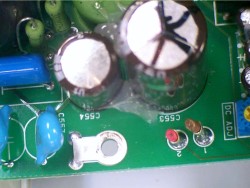
Gideon Analytical Laboratories received two power supply boards with components. The supplies were thought to have contamination, possibly bromine, causing corrosion or failing the electrolytic capacitor. The term electrolytic capacitor in a generic term for three different capacitors, which include aluminum electrolytic capacitors, tantalum electrolytic capacitors, and niobium electrolytic capacitors. All electrolytic capacitors are polarized capacitors whose anode is made of a particular metal on which an insulating oxide layer forms by anodization, acting as the dielectric of the electrolytic capacitor. Electrolytic capacitors may corrode if used or stored in a place where they encounter acidic toxic gases, like hydrogen sulfide, sulfurous acid, nitrous acid, chlorine, or bromine.

Ralec RTT20132JTE Resistors

Ralec RTT20132JTE Resistors

Gideon Analytical Laboratories received Printed Circuit Boards (PCBs) with Ralec RTT20132JTE resistors. A PCB is a mechanically supports and electrically connects electronic components or electrical components using conductive tracks, pads and other features etched from one or more sheet layers of copper laminated onto and/or between sheet layers of a non-conductive substrate. Components are generally soldered onto the PCB to both electrically connect and mechanically fasten them to it.  A resistor a passive two-terminal electrical component that implements electrical resistance as a circuit element. In electronic circuits, resistors are used to reduce current flow, adjust signal levels, to divide voltages, bias active elements, and terminate transmission lines, among other uses. High-power resistors that can dissipate many watts of electrical power as heat, may be used as part of motor controls, in power distribution systems, or as test loads for generators. The goal was to determine why the Ralec RTT20132JTE resistors were failing.

Sensor Failures

Sensor Failures

Gideon Analytical Laboratories received two image sensors with high impedance on the connector between pins 4 and 5, measuring 10 KHz. An image sensor or imaging sensor is a sensor that detects and conveys the information that constitutes an image. It does so by converting the variable attenuation of light waves (as they pass through or reflect off objects) into signals, small bursts of current that convey the information. The waves can be light or other electromagnetic radiation. Image sensors are used in electronic imaging devices of both analog and digital types, which include digital cameras, camera modules, medical imaging equipment, night vision equipment such as thermal imaging devices, radar, sonar, and others. kHz stands for kilohertz (10³ Hz). Hertz is the unit of frequency in the International System of Units (SI) and is defined as one cycle per second.It is named for Heinrich Rudolf Hertz, the first person to provide conclusive proof of the existence of electromagnetic waves. The goal was to analyze these sensors and identify the cause of increasing resistance.

ST Microelectronics BTA06-600B and Littlefuse Q6006L5 Triacs - Inspection for Microcracks

ST Microelectronics BTA06-600B and Littlefuse Q6006L5 Triacs - Inspection for Microcracks

Gideon Analytical Laboratories received twoST Microelectronics BTA06-600B and two Little fuse Q6006L5 triacs in TO-220AB packages. Inspection of the die for microcracking was requested.

We were happy to fulfill our client’s request. There were no mechanical marks on either device and the lead frame was tin-plated. The Triacs were electronically tested on a curve tracer. A curve tracer is a specialized piece of electronic test equipment used to analyze the characteristics of discrete semiconductor devices such as diodes,transistors, and thyristors. Based on an oscilloscope, the device also contains voltage and current sources that can be used to stimulate the device under test. The curve trace results revealed all four triacs were in working order. Devices were ten decapsulated and each die perimeter visually inspected. All dies were inspected for cracks. On the ST devices, sides of one of the die were not perfectly cut with the dicing saw, but no cracks were observed. Of the Little fuse devices, one device had no defects at all. The other device had silicon pieces plucked from the die, small cracking, and the inevitability of that crack propagating.

TI TPS54360 and MCC SK810L-TP on Rigid-flex Circuit

TI TPS54360 and MCC SK810L-TP on Rigid-flex Circuit

Gideon Analytical Laboratories received several rigid-flex printed circuit boards (PCBs), which containedTexas Instruments TPS54360 DC-DC converter and Micro Commercial Components Schottky rectifier SK810L-TP. The TI TPS54360 is a 60 V, 3.5 A, step down regulator with an integrated high side MOSFET. The device survives load dump pulses up to 65V per ISO 7637. Current mode control provides simple external compensation and flexible component selection. The SK810L-TP is Rohs compliant, has high current availability, and is for surface mount application. These rigid-flex PCBs, in turn, were receiving data and power from a 54V buss, which then interfaced and drive LEDs and LCG via a flex circuit. The task was to pay particular attention to theTI TPS54360 DC-DC converter and the MCC SK810L-TP rectifier.

Contamination on Capacitor Sleeves, Pins, Oscillator

Contamination on Capacitor Sleeves, Pins, Oscillator

Gideon Analytical Laboratories received a Printed Circuit Board (PCB) with contamination on several capacitor sleeves, connector pins, and an oscillator. An electrolytic capacitor is a capacitor whose anode (+) consists of pure aluminum foil with an etched surface, covered with a uniformly very thin barrier layer of insulating aluminum oxide, which operates as a dielectric. The electrolyte, which covers the rough surface of the oxide layer, operates as the second electrode, the cathode (-). E-caps have the largest capacitance values per unit volume compared to the two other main conventional capacitor families, ceramic and plastic film capacitors, but much smaller capacitance than similarly sized supercapacitors. Aluminum electrolytic capacitors are divided into three subfamilies by the type of electrolyte. There are non-solid (liquid, wet) aluminum electrolytic capacitors, solid manganese dioxide aluminum electrolytic capacitors, and solid polymer aluminum electrolytic capacitors. Basic parts to an electrolytic capacitor include anode foil, a dielectric, cathode foil, cathode oxide layer, non-solid electrolyte, paper spacer, conducting polymer, among other materials. An electronic oscillator is an electronic circuit that produces a periodic, oscillating electronic signal, often a sine wave or a square wave. Oscillators convert direct current (DC) from a power supply to an alternating current (AC) signal. They are widely used in many electronic devices. The goal was to identify the contamination on the capacitor sleeves, connector pins, and an oscillator.

Fairchild RFP40N10 power MOSFETs

Fairchild RFP40N10 power MOSFETs

Gideon Analytical Laboratories receivedthree Fairchild RFP40N10 power MOSFETs. A MOSFET is a specific type of metal oxide semiconductor field-effect transistor (MOSFET) designed to handle significant power levels.Compared to the otherpower semiconductor devices, for example, an insulated-gate bipolar transistor (IGBT) or athyristor, its main advantages are highswitchingspeed and good efficiency at low voltages. It shares with the IGBT an isolated gate that makes it easy to drive. They can be subject to low gain, sometimes to degree that the gate voltage needs to be higher than the voltage under control. The [Fairchild](http://Fairchild RFP40N10 power MOSFET) RFP40N10 power MOSFET is an N-Channel power MOSFET manufactured using MegaFET process, which uses featuresizes approaching those of LSI integrated circuits givesoptimum utilization of silicon. These MOSFETs were in TO-220AB packages. All of the terminals on theFairchild RFP40N10 power MOSFETs were shorted.

Vishay SS26 Surface Mount Schottky Barrier Rectifiers

Vishay SS26 Surface Mount Schottky Barrier Rectifiers

Gideon Analytical Laboratories received four Vishay SS26 Surface Mount Schottky Barrier Rectifiers for possible premature conditions to failure. A Schottky barrier is a potential energy barrier for electrons formed at a metal-semiconductor junction. Schottky barriers have rectifying characteristics, suitable for use as a diode. These Vishay SS26 Surface Mount Schottky Barrier Rectifiers feature a low profile package, high surge capability, and are RoHS compliant. The diodes came from PCB P/N 170310142001 Rev A03 S/N 051208-231. Positions D8, D9, D18, and D27 were identified as possible trouble spots. The goal was to determine the cause of failure.

Vishay TR3D685K050C0500 Tantalum Capacitors

Vishay TR3D685K050C0500 Tantalum Capacitors

Gideon Analytical Laboratories received several Vishay TR3D685K050C0500 tantalum capacitors for analysis. A  tantalum electrolytic capacitor is an electrolytic capacitor, a passive component of electronic circuits. It consists of a pellet of tantalum metal as an anode, covered by an insulating oxide layer that forms the dielectric, surrounded by a liquid or solid electrolyte as a cathode. Because of its very thin and relatively high permittivity dielectric layer, the tantalum capacitor distinguishes itself from other conventional and electrolytic capacitors in having a high capacitance per volume (high volumetric efficiency) and lower weight. The Vishay TR3D685K050C0500 tantalum capacitors having an operating temperature range between -55° C and 85° C, a voltage rating of 50V and a capacitance of 6.8uF. Of the several  TR3D685K050C0500s received, three samples were shorted,  were labeled as “good”, and two were golden virgin parts for comparison. The goal was to determine the cause of these failures, and Gideon Analytical Laboratories did just that.

Johanson Dielectrics PN 500T15W103MV4E MLCCs

Johanson Dielectrics PN 500T15W103MV4E MLCCs

Gideon Analytical Laboratories received two printed circuit board (PCB) assemblies, each of which had a single multilayer ceramic capacitor (MLCC) suspected of failing. These MLCCs are Johanson Dielectrics PN 500T15W103MV4E. A PCB mechanically supports and electrically connects electronic components using conductive tracks, pads and other features etched from copper sheets laminated onto a non-conductive substrate. Components (e.g. capacitors, resistors or active devices) are generally soldered on the PCB. Advanced PCBs may contain components embedded in the substrate. Multilayer ceramic capacitors are fixed value capacitors in which ceramic the material acting as the dielectric. It is made up of two or more alternating layers of ceramic and a metal layer acting as the electrodes. There are various types of materials that could function as the dielectric in a capacitor. The goal was to determine the cause of the Johanson Dielectrics PN 500T15W103MV4E MLCCs failure.

Knit Line and Thermal Cracking on MLCCs

Knit Line and Thermal Cracking on MLCCs

Gideon Analytical Laboratories received several Multi-Layered Ceramic Capacitors that had failed and two good MLCCs for comparison. The failure was occurring during the development cycle and it was thought this might be an issue with the manufacturing process. Multilayer ceramic capacitors are fixed value capacitors in which ceramic the material acting as the dielectric. It is made up of two or more alternating layers of ceramic and a metal layer acting as the electrodes. There are various types of materials that could function as the dielectric in a capacitor, for example, glass, porcelain, paper, or mica.

National LM5111-1M Dual 5A Compound Gate Drivers

National LM5111-1M Dual 5A Compound Gate Drivers

Gideon AnalyticalLaboratories received four National LM5111-1M dual 5A compound gate drivers. Two were failed and two were operational. A gate driver is power amplifier that accepts a low-power input from a controller IC and produces a high-current drive input for the gate of a high-power transistor such as an IGBT or power MOSFET. Gate drivers can be provided either on-chip or as a discrete module. In essence, a gate driver consists of a level shifter in combination with an amplifier. We received no information as to why theNational LM5111-1M dual 5A compound gate drivers were failing. But that never stopped Gideon Analytical Laboratories before. The goal was to determine the cause of the failures.

PCB Solder Mask Delamination

PCB Solder Mask Delamination

GideonAnalytical Laboratories received several Printed Circuit Boards (PCBs) that were experiencing delamination of the solder masks, specifically on the EMI filter card. A PCB mechanically supports and electrically connects electronic components using conductive tracks, pads and other features etched from copper sheets laminated onto a non-conductive substrate. Components (e.g. capacitors, resistors or active devices) are generally soldered on the PCB. Advanced PCBs may contain components embedded in the substrate. Electromagnetic interference (EMI), also called radio-frequency interference (RFI) when in the radio frequency spectrum, is a disturbance generated by an external source that affects an electrical circuit by electromagnetic induction, electrostatic coupling, or conduction.The disturbance may degrade the performance of the circuit or even stop it from functioning. In the case of a data path, these effects can range from an increase in error rate to a total loss of the data.

TE Corcom Failed EMI Filters 55Amp (55BCF6- F8236B) and 75A (75BCF6-F8237B)

TE Corcom Failed EMI Filters 55Amp (55BCF6- F8236B) and 75A (75BCF6-F8237B)

Gideon Analytical Laboratories received several failed 55 Amp (55BCF6- F8236B) and 75A (75BCF6-F8237B) TE Corcom EMI filters for failure analysis. These EMI filters used capacitors manufactured by Hua Jung Components (HJC). Electromagnetic interference (EMI), also called radio-frequency interference (RFI) when in the radio frequency spectrum, is a disturbance generated by an external source that affects an electrical circuit by electromagnetic induction, electrostatic coupling, or conduction. Most electronics contain an EMI filter, either as a separate device or embedded in circuit boards. Its function is to reduce high-frequency electronic noise that may cause interference with other devices. Regulatory standards exist in most countries that limit the amount of noise that can be emitted. All of the TE Corcom EMI filters were from the same vintage according to the outside label. The goal was to determine the cause of the failure.

Three Phase Inductor Card

Three Phase Inductor Card

Gideon Analytical Laboratories received two 3-phase inductor cards to be analyzed. Three Phase power is a three wire Alternating Current (AC) power circuit. Most US commercial buildings use a3 Phase 4 Wire 208Y/120V power arrangement because of its power density and flexibility.Compared to single phase, a 3phase power arrangement provides 1.732 (the square root of 3) times more power with the same current and provides (7) power circuits. An inductor is a passive two-terminal electrical component that stores electrical energy in a magnetic field when an electric current is flowing through it.An inductor typically consists of an electric conductor, such as a wire, that is wound into a coil. When the current flowing through an inductor changes, the time-varying magnetic field induces a voltage in the conductor, described by Faraday’s law of induction. According to Lenz’s law, the direction of induced electromotive force opposes the change in current that created it. The goal was to determine why these 3-phase inductors were failing.

Toshiba GT40T301S IGBT Failures on PCBs

Toshiba GT40T301S IGBT Failures on PCBs

Gideon Analytical Laboratories received two Printed Circuit Boards (PCBs) with failed Insulated-gate bipolar transistors (IGBTs). The IGBTs were Toshiba GT40T301s.  An insulated-gate bipolar transistor is a three-terminal power semiconductor device primarily used as an electronic switch which, as it was developed, came to combine high efficiency and fast switching. It switches electric power in many modern appliances: variable-frequency drives (VFDs), electric cars, trains, variable speed refrigerators, lamp ballasts, air-conditioners and even stereo systems with switching amplifiers. The IGBT is a semiconductor device with four alternating layers (P-N-P-N) that are controlled by a metal-oxide-semiconductor (MOS) gate structure without regenerative action. The respective IGBTs measured .4 ohms and 42.8 ohms between collector and emitter. The Ohm is the SI derived unit of electrical resistance, named after German physicist Georg Simon Ohm. The goal was to determine the cause of the failed IGBTs.

Vishay CRCW1210-HP-e3 SM Resistor Failures

Vishay CRCW1210-HP-e3 SM Resistor Failures

Gideon Analytical Laboratories received two PCB assemblies upon which were several failing Vishay CRCW1210-HP-e3 surface mount (SM) resistors. Surface mount technology (SMT) is a method for producing electronic circuits in which the components are mounted or placed directly onto the surface of printed circuit boards (PCBs). An electronic device so made is called a surface-mount device (SMD). In the industry, it has largely replaced the through-hole technology construction method of fitting components with wire leads into holes in the circuit board. The goal was to determine the cause of the failing Vishay CRCW1210-HP-e3 SM resistors.

Problems with Track Lighting

Problems with Track Lighting

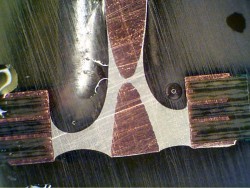
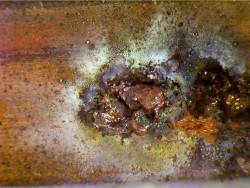
Gideon Analytical Laboratories received several lighting tracks for failure analysis. They all had what appeared to be arcing which caused severe copper pitting, melting of the Noryl, and distortion of the power bus bar. The neutral bus was also pitted but not nearly as bad as the power rail. Electrical arcing is an electrical breakdown of a gas that produces an ongoing electrical discharge. The current through a normally non-conductive medium such as air produces a plasma; the plasma may produce visible light. An arc discharge is characterized by a lower voltage than a glow discharge, and it relies on thermionic emission of electrons from the electrodes supporting the arc. An arc between two electrodes can be initiated by ionization and glow discharge, as the current through the electrodes is increased. The breakdown voltage of the electrode gap is a function of the pressure, the distance between electrodes and the type of gas surrounding the electrodes. When an arc starts, its terminal voltage is much less than a glow discharge, and current is higher. An arc in gases near atmospheric pressure is characterized by visible light emission, high current density, and high temperature. NORYL resins are a rare example of a homogeneous mixture of two polymers. Most polymers are incompatible with one another, so tend to produce separate phases when mixed. The two polymers compatibility in NORYL resins is due to the presence of a benzene ring in the repeat units of both chains. The goal was to determine why there was electrical arcing on these lighting tracks.

Electronic Transformers

Electronic Transformers

Gideon Analytical Laboratories received four electronic transformers, some of which were failing. Three transformers produced no output and the fourth was tested using an oscilloscope and found to function. Transformers are electrical devices typically used to transfer energy between two or more circuits using electromagnetic induction. Electromagnetic induction is the production of an electromotive force across a conductor when it is exposed to a varying magnetic field. Using Faraday’s Law with high magnetic permeability core properties, transformers can efficiently change AC voltages from one voltage level to another within a given power network. The goal was to find out the cause of these failures.

Light Switch Contamination

Light Switch Contamination

Gideon Analytical Laboratories received several lighting switches that were found to remain open even while the switch was closed. A light switch is most commonly used to operate electric lights, permanently connected equipment, or electrical outlets. Portable lamps such as table lamps will have a light switch mounted on the socket, base, or in-line with the cord. Manually operated on/off switches may be substituted by remote control switches, or light dimmers that allow controlling the brightness of lamps as well as turning them on or off. After a brief abrasion, the lighting connect switch functioned normally. The metal to metal interface made electrical contact at a point rather than the surface of the entire contact area. Contamination was suspected as the cause of this failure.

Soldering Problems Printed Circuit Boards

Soldering Problems Printed Circuit Boards

Gideon Analytical Laboratories received four Printed Circuit Boards which had either opens or intermittent behavior on some of the P1 connector pins. A Printed Circuit Board (PCB)mechanically supports and electrically connects electronic components using conductive tracks, pads and other features etched from copper sheets laminated onto a non-conductive substrate. PCBs can be single sided,double sided,or multi-layered. An open circuit is an incomplete electrical circuit in which no current flows. Gideon Analytical Laboratories was asked specifically if the soldering on the PCBs was problematic.

Leakage Current on Electrolytic Capacitors

Leakage Current on Electrolytic Capacitors

Gideon Analytical Laboratories received about 20 electrolytic capacitors which all had unacceptable leakage current. An electrolytic capacitor (also known as an e-cap) is a capacitor whose anode (+) consists of pure aluminum foil with an etched surface, covered with a uniformly very thin barrier layer of insulating aluminum oxide, which operates as a dielectric. The electrolyte, which covers the rough surface of the oxide layer, operates as the second electrode, the cathode (-). Electrolytic capacitors have a higher capacitance value per unit volume compared to the two other main conventional capacitor families, ceramic and plastic film capacitors. Leakage refers to the gradual loss of energy from a charged capacitor. It is primarily caused by electronic devices attached to the capacitors, such as transistors or diodes, which conduct a small amount of current even when they are turned off. The goal was to determine the cause of the leakage current in the 20 electrolytic capacitors.
PCB with Open in PTH

PCB with Open in PTH

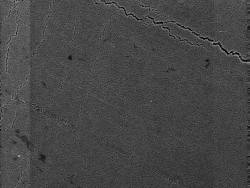
Gideon Analytical Laboratories received one printed circuit board (PCB) with an open in the plated through hole (PTH). A printed circuit board mechanically supports and electrically connects electronic components using conductive tracks, pads and other features etched from copper sheets laminated onto a non-conductive substrate.  Advanced PCBs may contain components - capacitors, resistors or active devices - embedded in the substrate. PCBs are used in all but the simplest electronic products. Plated through holes are a type of through-hole technology, which refers to the mounting scheme used for electronic components that involve the use of leads on the components that are inserted into holes drilled in PCBs and soldered to pads on the opposite side either by manual assembly or by the use of automated insertion mount machines. The goal was to determine whether or not contamination caused the open in the via.

Power Supply Analysis

Power Supply Analysis

Gideon Analytical Laboratories received a power supply with several bulging capacitors on the motherboard. A power supply is an electronic device that supplies electric energy to an electrical load. The primary function of a power supply is to convert one form of electrical energy to another and, as a result, power supplies are sometimes referred to as electric power converters. Some power supplies are discrete, stand-alone devices, whereas others are built into larger devices along with their loads. All power supplies have a power input, which receives energy from the energy source, and a power output that delivers energy to the load. In most power supplies the power input and output consist of electrical connectors or hardwired circuit connections, though some power supplies employ wireless energy transfer in lieu of galvanic connections for the power input or output. The power supply began to smoke when it was turned on. The goal was to determine the cause of the failures.

Vishay ES2D SM Rectifier

Vishay ES2D SM Rectifier

Gideon Analytical Laboratories, Inc. received on Vishay ES2D rectifier on a PCB. The initial condition and observation were that the diode had a conformal coating on a small circuit board in which when tested on a curve tracer had excessive leakage current across the junction and caused the PCB to fail in the application.

Rectifiers are primarily used for conducting in one direction and blocking in the other. The Vishay ES2D is an ultra-fast rectifier, which means the reverse recovery time should be less than 100 ns. Rectifiers are primarily used for power or signal conditioning in a variety of applications. This can range from high power output rectifier applications to low power switching rectifier requirements. They can be used for clamping networks on SMPS, dampening and modulating diodes on deflection circuits in CRTs, or freewheeling diodes on inductive loads etc.

153D8496G1 Circuit Card Assembly

153D8496G1 Circuit Card Assembly

Gideon Analytical Laboratories received two 153D8496G1 printed circuit boards (PCBs)for failure analysis. A PCB mechanically supports and electrically connects electronic components using conductive tracks, pads, and other features etched from copper sheets laminated onto a non-conductive substrate. Some of the electronic components that might appear on a PCB include semiconductors like diodes or transistors, discharge devices, power sources, resistors, and capacitors. The153D8496G1 circuit card assembly has 6 capacitors, 20 resistors, and 18 semiconductors all mounted to a printed wiring board. The capacitors on both153D8496G1 PCBs were open, and as a result of the leads disintegrating in the presence of voltage and flux. The goal was to find the reason why these capacitors on the PCBs were failing.

Atmel AT91SAM9260 Based Embedded MPU

Atmel AT91SAM9260 Based Embedded MPU

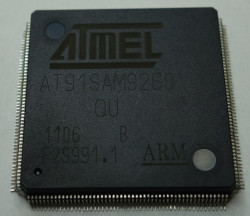
Gideon Analytical Laboratories, Inc. received Atmel AT91SAM9260 based Embedded MPU; it is a 180 MHz ARM926EJ-S ARM Thumb Processor. The SAM9260 is based on the integration of an ARM926EJ-S processor with fast ROM and RAM memories and a wide range of peripherals. It embeds an Ethernet MAC, one USB Device Port, and a USB Host controller. It also integrates several standard peripherals, such as the USART, SPI, TWI, Timer Counters, Synchronous Serial Controller, ADC, and MultiMedia Card Interface. The SAM9260 is architecture on a 6-layer matrix, allowing a maximum internal bandwidth of six 32-bit buses. It also features an External Bus Interface capable of interfacing with a wide range of memory devices. The device was with the concern that it did not function at 50C.The device was wired up in such a way to determine the continuity from the power, ground and I/O pins at room temperature and 55C. The testing revealed that the power and some I/O pins were intermittent at 55C. The device was put on a known good PCB with full functionality and it failed. A good Atmel was installed and it worked on the same PCB without any issues. The device was decapsulated revealing the wires bonds both on the lead frame and the die. As can be seen in the photographs, the die had several ball bonds that came off during decapsulation. The coefficient of thermal expansion is greater for the molding compound than it is for the gold balls. At higher temperature, this epoxy expansion moves the ball bonds and renders them intermittent. No bond issues were noted on the interconnects to the lead frame. The bonding issue was primarily on one side of the die and primarily with one lot. This was a manufacturing issue.

N-channel JFET 2N4856

N-channel JFET 2N4856

Gideon Analytical Laboratories received several failed N-channel JFET 2N4856 parts. Several good N-channel JFET 2N4856 parts were also provided for comparison. A junction gate field-effect transistor (JFET) is a simple type of field-effect transistor. JFET source, respectively. The JFET 2N4856 were taken out of the application because of a waveform distortion at elevated temperature. The suggestion was to identify an electrical parameter (one or more) by which these unstable JFETs could be eliminated by a screen.

Failure Analysis on 07639SOCN FK230003P1 26522-N45 Transformers

Failure Analysis on 07639SOCN FK230003P1 26522-N45 Transformers

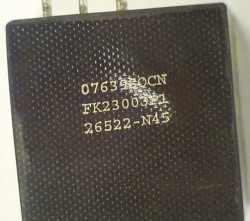
Gideon Analytical Laboratories received two07639SOCN FK230003P1 26522-N45 transformers for electronic failure analysis. Transformers are electrical devices typically used to transfer energy between two or more circuits using electromagnetic induction. Electromagnetic induction is the production of an electromotive force across a conductor when it is exposed to a varying magnetic field. Using Faraday’s Law with high magnetic permeability core properties, transformers can efficiently change AC voltages from one voltage level to another within a given power network. One transformer had a lower expected resistance on pins 4-6 and the other had a resistance changing when the temperature was elevated. The goal was to perform failure analysis on these transformers.

Failure Analysis on JanTX1N649-1 Diodes

Failure Analysis on JanTX1N649-1 Diodes

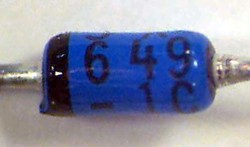
Gideon Analytical Laboratories received two Microsemi JanTX1N649-1 diodes for electronic failure analysis. A diode is a two-terminal electronic component with asymmetric conductance. It has low resistance to current flow in one direction, and high resistance in the other direction. There are various kinds of diodes, including vacuum tube diodes and solid state diodes. The most used and ubiquitous diode is the semiconductor. The JanTX1N649-1 is a voltage regulator diode is ideal for high-reliability applications where a failure cannot be tolerated. They are 1.5-watt voltage regulators that are hermetically sealed with a void-less glass construction using an internal metallurgical bond.

Failure Analysis on MLCCs

Failure Analysis on MLCCs

Gideon Analytical Laboratories received two multilayer ceramic capacitors (MLCCs)for failure analysis. Multilayer ceramic capacitors are fixed value capacitors in which the ceramic is acting as the dielectric material. It is made up of two or more alternating layers of ceramic and a metal layer acting as the electrodes. There are various types of materials that could function as the dielectric in a capacitor, for example, glass, porcelain, paper, or mica. They were not EU ROHS compliant. Their capacitance value was 0.0047uF. Their max voltage was 50VDC; they had a C0G dielectric, were surface mounted, and had a maximum operating temperature of 125° C. Failure analysis was conducted to determine the cause of the failures.

RNC70H1963FS Resistor Failure

RNC70H1963FS Resistor Failure

Gideon Analytical Laboratories received an RNC70H1963FS resistor for electronic failure analysis. A resistor is a passive two-terminal electrical component that implements electrical resistance as a circuit element. Resistors act to reduce current flow, and, at the same time, act to lower voltage levels within circuits. They are typically constructed of metal wire or carbon and engineered to maintain a stable resistance value over a wide range of environmental conditions. Resistors are rated both in terms of their resistance (ohms) and their ability to dissipate heat energy (watts). The RNC70H1963FS resistor has an electrical resistance of 196 ohms, and his a power dissipation rating of 0.500 Watts. The goal was to find the cause of the RNC70H1963FS resistor.

Vishay 5962-9562301Q3A, Integrated Circuit Failure Analysis

Vishay 5962-9562301Q3A, Integrated Circuit Failure Analysis

Gideon Analytical Laboratories received two integrated circuits for failure analysis. Integrated circuits (ICs) are an assembly of electronic components, fabricated as a single unit, in which miniaturized active devices (like transistors and diodes) and passive devices (like capacitors and resistors) and their interconnections are built upon a thin substrate of semiconductor material. One was a Texas Instruments 5962-9861201QXA and the other was a Vishay 5962-9562301Q3A. The Texas Instruments 5962-9861201QXA was a DSP fixed-point 16-Bit 40MHz 20MIPS 132-Pin CFPAK. The Vishay 5962-9562301Q3A analog switch multiplexer was a single 16:1 28-Pin LCC with a 44V maximum supply voltage rating. The goal was to determine why these two integrated circuits were failing.

Linear Microcircuit Modular Hybrid

Linear Microcircuit Modular Hybrid

Gideon Analytical Laboratories received one linear microcircuit modular hybrid FK23009 for electronic failure analysis. A hybrid integrated circuit (HIC) is a miniaturized electronic circuit constructed of individual devices, such as semiconductors and passive components like resistors or inductors, and typically encapsulated in epoxy. The hybrid microcircuit is used in military and communications applications and is excellent for creating custom analog circuits, such as amplifiers and modulators. Thick film technology is often used as the interconnecting medium for hybrid integrated circuits. The modular hybrid FK23009 had no output on lead 1. The goal was to perform electronic failure analysis and discover the reason why it failed.

Contamination on Synchronization Supply Units (SSU)

Contamination on Synchronization Supply Units (SSU)

Gideon Analytical Laboratories received several Synchronization Supply Units (SSU); the covers of the SSU had contamination on them. Synchronization Supply Units are important in modern digital telecommunications networks because components of the network need to be accurately synchronized. The SSU ensures reliable distribution of the time signal kept by a Primary Reference Clock (PRC). There were stains located near the Capacitor -input filters (Pi filters) on both sides of the cover of the SSU. Capacitor-input filters are a type of electronic filter used to remove unwanted frequencies from a signal. They are called “Pi” filters because of their resemblance to the Greek letter “Pi”. The goal was to perform a chemical analysis of the contamination.

LM5111-1M Dual 5A Compound Gate Drivers

LM5111-1M Dual 5A Compound Gate Drivers

" Gideon Analytical Laboratories received four National Semiconductor LM5111-1M dual 5A compound gate drivers. A gate driver is a power amplifier that accepts low-power input from a controller integrated circuit and produces a high-current drive input for the gate of a high power transistor. These LM5111 Dual Gate drivers have high peak output current and efficiency. Each of the compound output driver stage includes MOS and bipolar transistors operating in parallel that together sink more than 5A peak from capacitive loads. Each device will drive two N-Channel MOSFETs. Two devices were failures and the other two were good devices. The goal was to determine the cause of the failures.

PTE43-31-C-RA Power Supplies

PTE43-31-C-RA Power Supplies

Gideon Analytical Laboratories received three PTE43-31-C-RA power supplies, two were failed and the other was a working device for comparison. Power supplies are devices that supply electrical power to an electrical load. Some power supplies convert alternating current (AC) to direct current (DC) for use in a variety of electronics. Typically, a computer needs a power supply that will convert 120 Volt AC power oscillating at 60 Hertz (Hz). Power supplies are vital to most electronic endeavors, like electrical components in machines, process automation, or for power generation. OnePTE43-31-C-RA power supply had a problem with the 5 volt (V) output line; it was going below the toleration limit of the processor and shutting down. Gideon Analytical Laboratories was determined to find the reason for this failure.

Trimpot Potentiometer Failures

Trimpot Potentiometer Failures

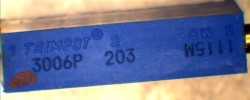
Gideon Analytical Laboratories received several Bourns Trimpot Trimming Potentiometers for failure analysis. A Potentiometer (known as a pot) is a three-terminal resistor with a sliding contact that forms an adjustable voltage divider. They are widely used for volume control in radio and television receivers. The Bourns Trimpot Trimming Potentiometer 3006P 203 has a standard resistance range of 10 to 5 megohms, the power rating of 400 volts maximum, and is ROHS compliant. Gideon Analytical Laboratories received good and bad units for comparison. The failures were addressed as having higher resistance or open.

144A9284P4 Resistors

144A9284P4 Resistors

Gideon Analytical Laboratories received several GE Aviation 144A9284P4 carbon film resistors for failure analysis evaluation. A resistor is a passive two-terminal electrical component that implements electrical resistance as a circuit element. Their purpose is for creating a precise quantity of resistance for insertion into a circuit; they are typically constructed of metal wire or carbon and engineered to maintain a stable resistance value over a wide range of environmental conditions. They are frequently integrated within integrated circuits within the silicon; the resistor changes the voltage or the current in the line. It’s measured in ohms (Ω). There were five working and five failed 144A9284P4 carbon film resistors. The failed resistors exceeded the 2% tolerance designated for this type of carbon film resistor.

LCD Analysis

LCD Analysis

Gideon Analytical Laboratories received several liquid-crystal displays (LCDs) that had fading issues; there were five failing LCDs and a good LCD for comparison. An LCD is a flat panel display, electronic visual display, or video display that uses the light modulating properties of liquid crystals. LCDs are extremely common in electronic devices such as laptops, digital clocks, and watches, pocket calculators, microwave ovens, or CD players. LCDs are also used in televisions and produce a sharp and vivid image. LCDs are can be small, inexpensive to manufacture, and do not draw a lot of power. The LCDs that were received had fading issues on the side closest to the seal. The fading had occurred over time. The goal was to determine the cause of these failures.

NEC Inverter Board

NEC Inverter Board

Gideon Analytical Laboratories received three sample NEC 104PW161 power inverter boards for failure analysis. A power inverter is designed to convert direct current (DC) to alternating current (AC). Inverters are used to operate all types of electrical equipment that uses batteries. DC current is what batteries store, but most electrical devices need AC current. These NEC104PW161 inverters had an output voltage of 520V and an output current of 5.5mA. The goal was to determine why they were failing.

FTIR of LEDs

FTIR of LEDs

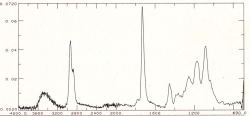
Gideon Analytical Laboratories received a Unity PLCC LED and was asked to perform FTIR analysis for the purpose of materials compatibility. Fourier transform infrared spectroscopy (FTIR) is a process used to acquire an infrared spectrum of absorption, emission, or photoconductivity of some substance. It can work with solids, liquids, or gasses, and can reveal the chemical composition of numerous materials. Gideon Analytical Laboratories was asked specifically to utilize FTIR on two substances: a white encapsulate and a clear/colorless material.

Thermal Evaluation (TMA and DSC)

Thermal Evaluation (TMA and DSC)

Gideon Analytical Laboratories performed thermal mechanical analysis TMA and differential thermal analysis (DSC) on two plastics which compose the encapsulation of Unity LEDs. TMA is a measurement of a change of a dimension or a mechanical property when it is subjected to a temperature regime. DSC is a technique for quantitatively analyzing the chemical composition of a substance by observing its thermal behavior while being heated. The samples were disassembled and separated into three items to analyze; the white casing, the clear resin, and the clear core material.

Flex Circuit Failure

Flex Circuit Failure

Gideon Analytical Laboratories received three failed Kapton based flex circuits with opens in the trace lines. The origin of the open was not known. The opens in the trace lines were traced down on the Kapton to several eyelets where contact was supposed to be made.

No areas were distinguished and no anomalies were found suggesting a trace copper foil problem on any of the circuits received. A cross-section of the above trace line and eyelet demonstrates the trace line (the line in the middle) either has been dislodged from the barrel or was never connected.

220 Picofarad AVX Capacitor

220 Picofarad AVX Capacitor

Gideon Analytical Laboratories received four 220 picofarad AVX capacitors for failure analysis. There are a variety of capacitors, including ceramic, aluminum, film, and tantalum, but all serve the same purpose, which is to store electrical charge. They are passive electrical components with at least two electrical conductors separated by an insulator (dielectric). The four220 picofarad AVX capacitors were giving low resistance readings.

Failure analysis ensued. The four 220 picofarad AVX capacitors were inspected for mechanical cracks, which would propagate upon voltage; no cracks were found on the external ceramic. The capacitors were measured and tested on a curve tracer since they had low resistance, otherwise, an IR meter would be used. The current was gradually increased to the point where dendrites would burn out. The resistance was measured again. No change occurred. The capacitors were baked and then retested again; no appreciable change occurred in resistance measurements. These test results indicate there was most likely an internal problem with the capacitor.

Failure Analysis of LM386 Op-amps

Failure Analysis of LM386 Op-amps

Gideon Analytical Laboratories received two semi-operational LM386 operational amplifiers for failure analysis. An operational amplifier (op-amp) is a DC-coupled high-gain electronic voltage amplifier with a differential input and, usually, a single-ended output. Op-amps are linear devices that have all the properties required for DC amplification and are used in signal conditioning, filtering, or to perform a variety of mathematical operations. The op-amps received were reported to have quiescent current 2 to 3 times the normal value. The goal was to determine the cause the failure.

Pulse Transformers Failure Analysis

Pulse Transformers Failure Analysis

Gideon Analytical Laboratories received six pulse transformers, three of which were failures, three of which were reliable. The objective was to determine the cause of the failures and inspect the unused transformers for anything that could contribute to the cause of failures. Transformers are devices that transfer electric energy from one circuit to another, usually with a change in voltage. Pulse transformers are transformers optimized for transmitting rectangular electrical pulses. Ideally, pulse transformer designers try to minimize voltage droop, rise time, and pulse distortion. Gideon Analytical Laboratories conducted a thorough failure analysis on these pulse transformers.

UPS Filter Capacitor Failure Analysis

UPS Filter Capacitor Failure Analysis

Gideon Analytical Laboratories received an Areovox Z26P6045M21 45uF 600V capacitor for failure analysis. Capacitors are passive two-terminal electrical components used to store electricity in an electric field. Inside most capacitors, there are two metal plates separated by a non-conducting substance (dielectric). Filter capacitors are used for filtering undesirable frequencies and removing voltage or signal spikes in electronic circuits. They are utilized in a variety of applications. Gideon Analytical Laboratories performed failure analysis the Areovox Z26P6045M21 45uF 600V capacitor.