Capacitor Failure Analysis

There are a wide variety of passive type capacitors made. This category will illustrate and display some failures we have had in the past.

Success Stories

Spectrum Control Filters

Spectrum Control Filters

Gideon Analytical Laboratories received four Spectrum Control Pi filters  N49927 Bus A (capacitor components FL1, FL2, FL3, and FL4). Capacitor-input filters (also known as Pi filters) are a type of electronic filter used to remove unwanted frequencies from a signal. Pi filters are primarily constructed of two capacitors and an inductor. They are used in situations where the ripple of a signal or the AC and DC currents within the signal are found to interfere with each other. Components FL1 and Fl3 had resistance measurements indicating that they were shorted. The goal was to determine the cause of the short.
Varactor Diode GVD30601-001

Varactor Diode GVD30601-001

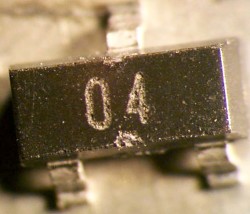
Gideon Analytical Laboratories received several GVD30601-001 super hyperabrupt junction tuning varactor diodes with a latent failure mechanism over time. A varactor diode is a P-N junction diode that changes its capacitance and the series resistance as the bias applied to the diode is varied. Hyperabrupt tuning varactor diodes offer a large change in junction capacitance over a small tuning voltage range. Varactors are operated in a reverse-bias state, like a Zener diode. Thus, no current flows, but since the thickness of the depletion zone varies with the applied bias voltage, the capacitance of the diode can be made to vary. The depletion region thickness is proportional to the square root of the applied voltage; capacitance is inversely proportional to the depletion region thickness. Thus, the capacitance is inversely proportional to the square root of the applied voltage. The goal was to find the cause if the GVD30601-001 varactor failures.

Failure Analysis on Microwave Capacitors

Failure Analysis on Microwave Capacitors

The analysis was performed on ten failed microwave capacitors. They were Samwha vintage 2100VAC .65uF with 3 percent tolerance with a maximum temperature rating of 85oC. All the capacitors were tested for shorts or opens. The resistance of the integrated resistor was measured also. None of the integrated resistors failed. They all varied from 9.75-M ohms to 10.85M ohms. Many of the capacitors saw considerable heat. This was evident by the bulging deformed metal can housing. When several of these capacitors were taken apart the dielectric fluid burst out under pressure. In order for such pressure to exist internally, the dielectric fluid has broken down forming a gas, the volume of the byproducts is larger than the initial conditions or another gas was produced by another means. All capacitor failures were identical in that the burned spot is always at the top of the aluminum foil, as revealed in the picture above. The presence of a residual black material on the rivet was detected. This material is coming from the encapsulation used on the surface of the resistor. When the black material is analyzed by SEM-EDS, it was found that all the black material contains copper and iron. There exists a material incompatibility problem between the integrated resistor encapsulate and the dielectric fluid.