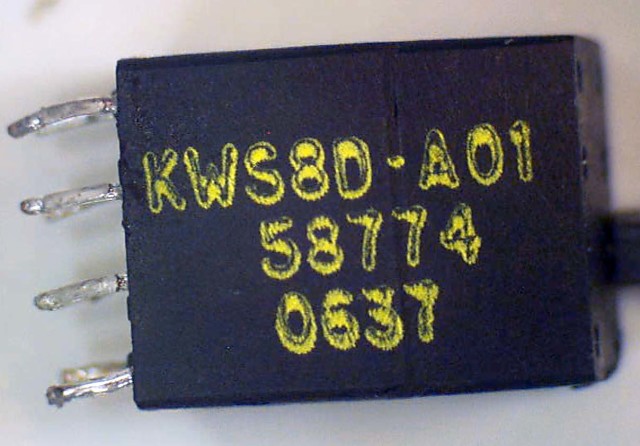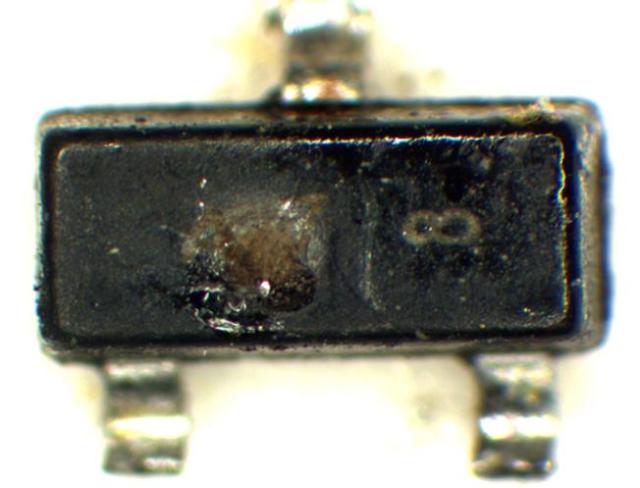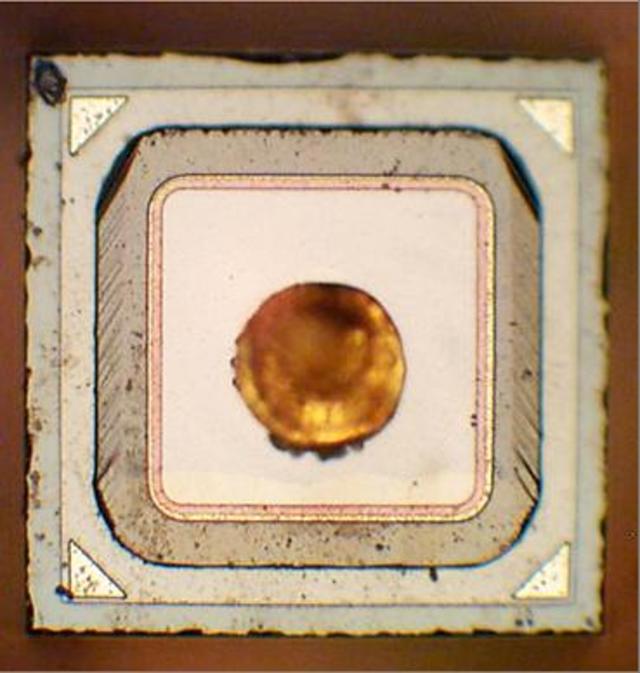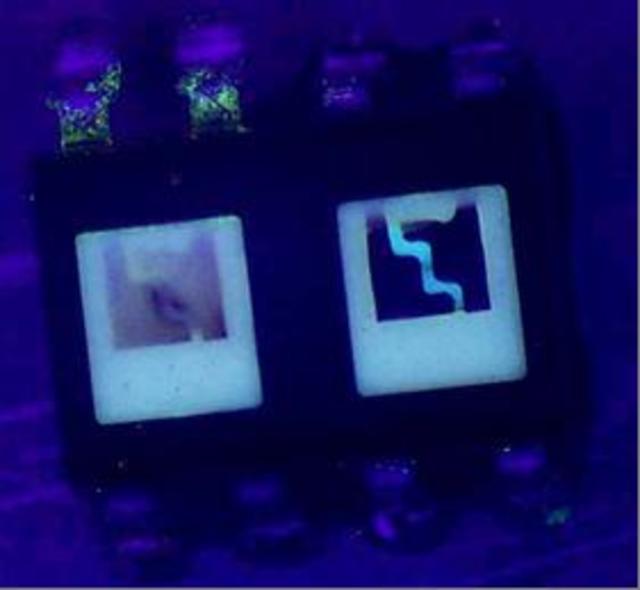
A diode allows current to flow in one direction and blocks it in the other. Diodes are used for rectification, signal switching, voltage clamping and protection. The main types are signal, rectifier, Schottky, Zener and light-emitting diodes (LEDs).
Diodes fail in a few common ways. Electrical overstress (EOS) can melt metal or damage the junction. Mechanical stress can crack the die or the glass body, which causes an open circuit, an intermittent connection or a leakage path. Moisture or contamination can raise leakage current, and a poor solder or die-attach bond can open the circuit at high temperature.
The case studies in this category include a glass-sealed diode in a display socket that cracked from lead stress. Others include a signal diode with EOS damage to its epoxy body and silicon rectifier diodes that opened at high temperature.
The lab usually begins with curve tracing to find the electrical failure mode. We then decapsulate or open the part and inspect the die with optical microscopy. Scanning electron microscopy and X-ray radiography help when more detail is needed.
If you have failed diodes, request a quote and send us a description of the failure.
Cracked Glass Diode in a Display Socket: Failure Analysis
Gideon Analytical Laboratories received Wamco Display Socket 4160001-1 for failure analysis. The device had a reported open diode on pin G. …
November 21, 2012EOS of Signal Diode
Gideon Analytical Laboratories received two integrated load switches and two small signal diodes for analysis. The integrated load switches …
January 4, 2012BZT52B5V6-V Diode Failures
Gideon Analytical Laboratories performed failure analysis on several BZT52B5V6-V Zener diodes with dead shorts. The most common function of …
June 3, 2011Optocoupler Failures
Gideon Analytical Laboratories received two failed photocouplers for failure analysis. These photocouplers feature a high isolation voltage, …
May 26, 2010Poor Process Control Lead to Over Current Failure
Gideon Analytical Laboratories received several printed circuit boards (PCB) with fire damage on one and electrical overstress on the …
December 10, 20091N4148 Glass Diode Failures
Gideon Analytical Laboratories received several intermittent diodes failures and two good ones for comparison. The failed devices were …
April 27, 2005