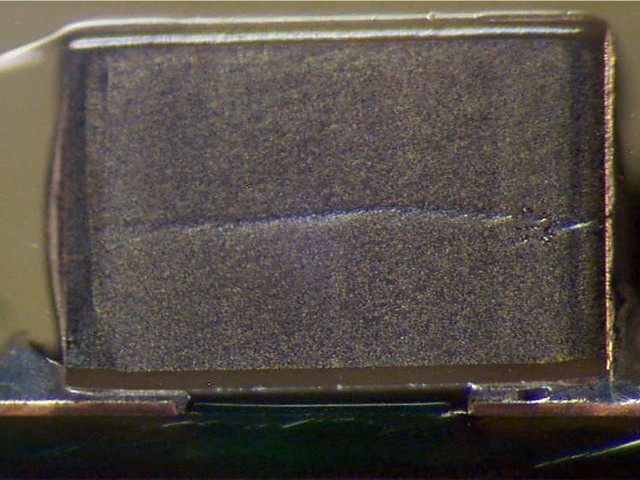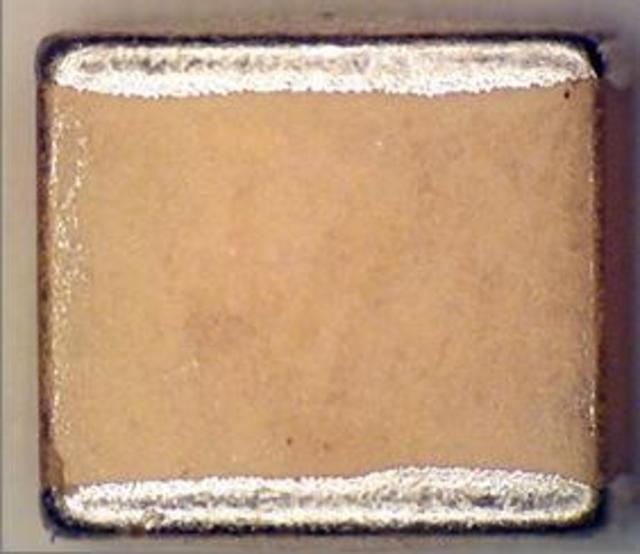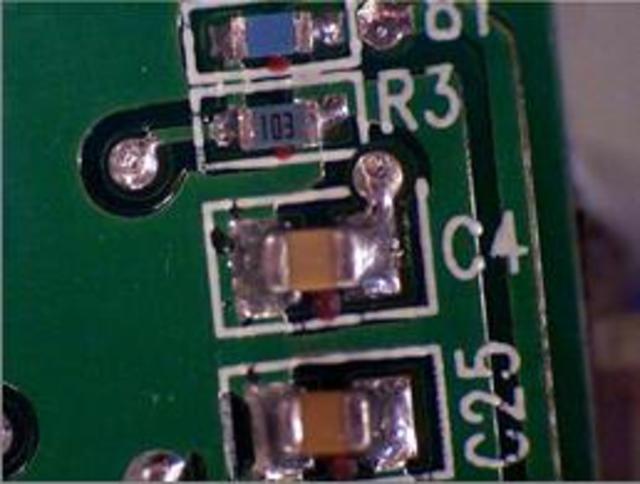
A multilayer ceramic capacitor (MLCC) is a small surface-mount part made of alternating ceramic dielectric and metal electrode layers. MLCCs are common in decoupling and filtering circuits, so one failed part can stop a whole board.
Ceramic is brittle. Board flexing is a common cause of cracks, for example during depanelization, handling or mounting. A difference in thermal expansion between the ceramic and the PCB adds stress during soldering and temperature cycling. Other failure modes include knit-line and thermal cracks, delamination, poor solder wetting, moisture or contamination that causes leakage current, and electrical overstress (EOS).
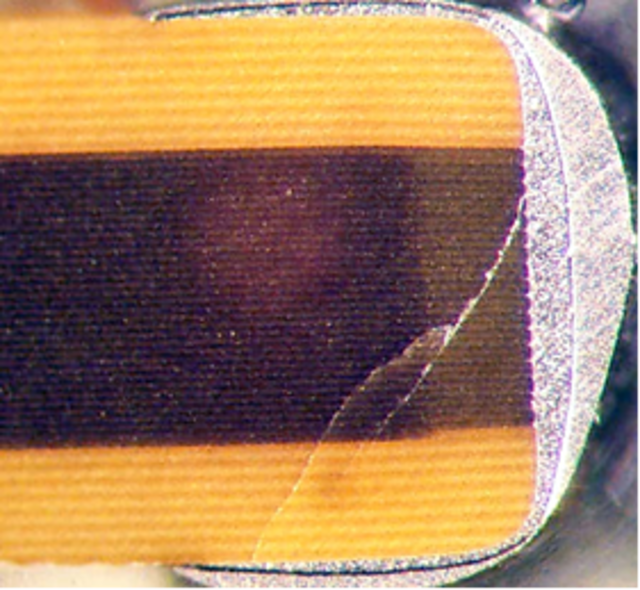
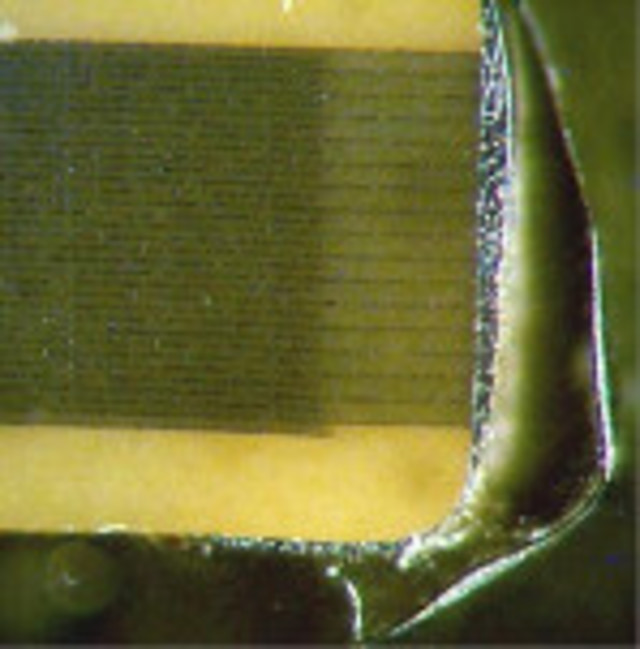
Our case studies in this category show these failure modes. One board had capacitors with cracks near the terminal caused by PCB flexing. Another set of parts had knit-line and thermal cracks.
For each job, the lab starts with electrical tests, including leakage current. We then use optical microscopy and cross-sectioning of the capacitor to find cracks, voids and delamination. Where needed, we use X-ray radiography and scanning electron microscopy to look deeper.
If you have failed MLCCs, request a quote and tell us about the failure and the application.
Capacitor Terminal Crack
Gideon Analytical Laboratories received 19 multilayered ceramic capacitors (MLCCs). MLCCs have a ceramic dielectric, a ceramic or lacquered …
March 31, 2013Looking for Flexiterm on MLCCs
Gideon Analytical Laboratories received six MLCC on power cards. MLCC are multilayer ceramic capacitors. A ceramic capacitor is fixed value …
March 29, 2013MLC Capacitor Failure Analysis (MLCC)
Gideon Analytical Laboratories received one failed multilayer ceramic capacitor for failure analysis. The image below is from Wikipedia. It …
November 26, 2012MLCC Cracks and Poor Solder Wetting: Failure Analysis
This is the same terminal where the EOS occurred. There are multiple cracks on the capacitor near the bottom. This is due to board flexing, …
November 21, 2012MLCC Failures
Gideon Analytical Laboratories received several PCBs with MLCC capacitors mounted near the circuit board edge. The capacitors had a …
November 21, 2012PCB Overheating Due to Design Flaw
Gideon Analytical Laboratories received several SVAA-3V25 relays for failure analysis. These solid state relays have a control voltage range …
August 29, 2011PCB Poor Solder Lead to EOS MLCC Fracturing
Gideon Analytical Laboratories received two 0805 MLCC capacitors mounted on daughter boards and several good capacitors for comparison. One …
April 1, 2008MLCC Cracking
Gideon Analytical Laboratories received a PCB with possible failed capacitors in several positions. PCBs are used to mechanically support …
January 7, 2008Multilayer Ceramic Capacitor (MLCC) Fracture
Gideon Analytical Laboratories performed failure analysis on several SM Syfer SM MLC Capacitors (also known as MLCC failures). The goal was …
March 5, 2007Multilayer Ceramic Capacitor
Gideon Analytical Laboratories received 100 capacitors and directed to analyze them via cross-sectional analysis. Capacitors store charges …
April 21, 2006Printed Circuit Board Flexing During Depanelization
Gideon Analytical Laboratories received two printed circuit boards (PCB) with the questionable failure of multilayer ceramic capacitors in …
March 10, 2005