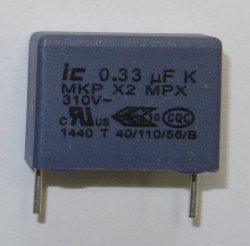
IC EMI MKP .33uF Film Capacitors Failures
Gideon received six used IC .33uF K MKP X2 MPX film capacitors with lower than expected capacitance for failure analysis. EMI suppression capacitors are used to suppress any noise from an electronic device by reducing the input impedance of the device. These types of capacitors have 2 classifications, X and Y. The X-type connects line to line. X capacitors have three categories; X1, X2, and X3. These are based on voltage. Class X1 is used where the peak voltage is greater than 2500 volts and less than 4000V. Class X2 used in applications where the peak voltage is equal to below 2500 volts. Class X3 are used where the peak voltage is less than or equal to 1200 volts. Y capacitors are connected from line to ground. They most often have a low capacitance value. If a Y capacitor fails, the potential for electrical shock is present. OUCH!!! Y capacitors have four categories, Y1, Y2, Y3, and Y4. Y1 capacitors are used with voltages up 500Vac, Y2 with voltages up to 300Vac, Y3 with voltages up to 250Vac and Y4 with voltages up to 150Vac. X class capacitors are rated up to 660Vac and Y capacitors are manufactured with voltage ratings up to 440Vac. X class capacitors are manufactured with a variety of dielectric materials. This includes polyester, polypropylene, ceramic and paper while Y capacitors are typically produced out of ceramic and paper dielectrics.
