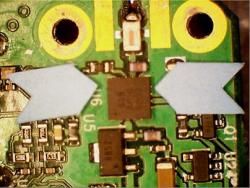
PCB with Amplifier Failed from EOS
Gideon Analytical Laboratories received a single MA COM MAAPSS0096 1 watt power amplifier for failure analysis. The device was thought to have some impedance issues.
The device was still attached to PCB on arrival, as displayed in the picture at the top left. The device was removed from the PCB and tested to find any indication of the condition of the internal circuitry. The MAAPSS0113 is a three stage power amplifier designed for Digitally Enhanced Cordless Telephone applications. The power amplifier is available in a lead-free 3 mm 12-lead PQFN plastic package. The MAAPSS0113 features an integrated power enable pin (5) for accurate ramp control and a separate power mode pin (2) for current savings in a low power mode state. Both control pins operate with 1.7 V logic. A voltage compensation circuit is also included for applications where the amplifier supply voltage is not regulated and is directly connected to the battery.