XRF

Success Stories

Contamination and Moisture on MLCCs

Contamination and Moisture on MLCCs

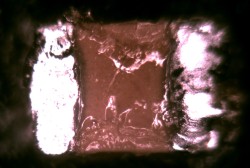
Gideon Analytical Laboratories received a printed circuit board (PCB) with suspected failing multi-layered ceramic capacitors (MLCC). Multilayer ceramic capacitors are fixed value capacitors in which ceramic the material acting as the dielectric. It is made up of two or more alternating layers of ceramic and a metal layer acting as the electrodes. There are various types of materials that could function as the dielectric in a capacitor, for example, glass, porcelain, paper, or mica. Each PCB has four suspected failing MLCCs, and the goal was to determine the cause of these failures.

Corrosion on Polyimide and Silicone PSA

Corrosion on Polyimide and Silicone PSA

Gideon Analytical Laboratories received a flex circuit with a mystery corrosion on the polyimide and silicone pressure sensitive adhesive (PSA). There was corrosion by-product, and the silicone adhesive appeared more like a gelatinous material than a tactic PSA. Contrary to popular belief, flex circuits are not training for a future bodybuilding competition, they are a technology for assembling electronic circuits by mounting electronic devices on flexible plastic substrates, such as polyimide, PEEK or transparent conductive polyester film. Additionally, flex circuits can be screen printed silver circuits on polyester. Flexible electronic assemblies may be manufactured using identical components used for rigid printed circuit boards, allowing the board to conform to the desired shape, or to flex during its use. A polyimide is a polymer of imide monomers, and have been in mass production since 1955 due to their diverse applications. The goal was to figure out what the mysterious corrosive substance on the polyimide and silicone PSA on the flex circuit was.