Success Stories and Solved Problems

Chemi-Con KMG Series 400V 22uF 6U Capacitors

Chemi-Con KMG Series 400V 22uF 6U Capacitors

Gideon Analytical Laboratories received six United Chemi-Con KMG series 400V 22uF 6U capacitors for the specific purpose of determining whether or not they had the presence of chlorides.

The analysis was performed using SEM-EDS. The SEM-EDS system gave elemental analysis in relation to the intensity of the element at a specific wavelength or energy level (Kev). SEM-EDS is an analytical technique used for the elemental analysis or chemical characterization of a sample. It relies on an interaction of some source of X-ray excitation and a sample. Its characterization capabilities are due in large part to the fundamental principle that each element has a unique atomic structure allowing a unique set of peaks on its electromagnetic emission spectrum.Theelectron-volt is used to measure energy. It is defined as the amount of energy an electron gains after being accelerated by 1 volt of electricity.

Contamination on HID Lamp Assemblies

Contamination on HID Lamp Assemblies

Gideon Analytical Laboratories received several high-intensity discharge lamp (HID) assemblies for determination and cause of a white powder-like substance on the inside of the lens housing. The white powder diminishes the reflective properties of the light and overall effectiveness. HID lamps are a type of electrical gas-discharge lamp which produces light by means of an electric arc between tungsten electrodes housed inside a translucent or transparent fused quartz or fused alumina arc tube. The three-man types of HID lamps are mercury, sodium, and metal halide. These lamps are known for their high efficiency at turning electricity into light and their long rated life. HID lamps require a ballast in order to generate the initial surge of electricity needed to start them and to regulate their power during normal operation.

EDS Analysis on EEPROM Devices

EDS Analysis on EEPROM Devices

Gideon Analytical Laboratories received 22 EEPROM devices for analysis of the lead plating. EEPROM stands for electrically erasable programmable read-only memory and is a type of non-volatile memory used in computers and other electronic devices to store relatively small amounts of data but allowing individual bytes to be erased and reprogrammed. EEPROMs are organized as arrays of floating-gate transistors. EEPROMs can be programmed and erased in-circuit, by applying special programming signals. Originally, EEPROMs were limited to single byte operations which made them slower, but modern EEPROMs allow multi-byte page operations. Unlike EPROM chips, EEPROMs do not need to be removed from the computer to be modified. However, an EEPROM chip has to be erased and reprogrammed in its entirety, not selectively. It also has a limited life - that is, the number of times it can be reprogrammed is limited to tens or hundreds of thousands of times. EDS analysis was conducted on all of the EEPROM devices we received.

Fairchild RV4140A GFI Controller/Monitors

Fairchild RV4140A GFI Controller/Monitors

Gideon Analytical Laboratories received two Fairchild RV4140A Ground Fault Interrupt Controller/Monitors in eight-pin SOIC packages. The Fairchild RV4140A is low power controller for AC outlet appliance leakage circuit interrupters. These devices detect hazardous current paths to ground such as an appliance falling into water. The interrupter then opens the circuit before a harmful or lethal shock occurs. A SOIC package is a surface-mounted integrated circuit (IC) package which occupies an area about 30 to 50 % less than an equivalent dual in-line package (DIP), with a typical thickness that is 70 % less. They are generally available in the same pin-outs as their counterpart DIP ICs. The impedance from pins 8 to 4 was low on both devices. The goal was to determine why.

Metal Castings

Metal Castings

Gideon Analytical Laboratories received two metal castings. One was a cylinder and the other was an insert to the bottom of the cylinder. Metal means a process, in which liquid metal is poured into a mold, that contains a hollow cavity of the desired shape, and then allowed to cool and solidify. The solidified part is also known as a casting, which is ejected or broken out of the mold to complete the process. Traditional techniques include lost-wax casting, plaster mold casting and, sand casting. The modern casting process is subdivided into two main categories: expendable and non-expendable casting. There was some form of contamination on the two metal castings that were received, and the goal was to determine what it was.

Possible Bromine on Electrolytic Capacitors

Possible Bromine on Electrolytic Capacitors

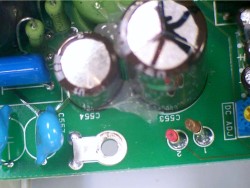
Gideon Analytical Laboratories received two power supply boards with components. The supplies were thought to have contamination, possibly bromine, causing corrosion or failing the electrolytic capacitor. The term electrolytic capacitor in a generic term for three different capacitors, which include aluminum electrolytic capacitors, tantalum electrolytic capacitors, and niobium electrolytic capacitors. All electrolytic capacitors are polarized capacitors whose anode is made of a particular metal on which an insulating oxide layer forms by anodization, acting as the dielectric of the electrolytic capacitor. Electrolytic capacitors may corrode if used or stored in a place where they encounter acidic toxic gases, like hydrogen sulfide, sulfurous acid, nitrous acid, chlorine, or bromine.

Ralec RTT20132JTE Resistors

Ralec RTT20132JTE Resistors

Gideon Analytical Laboratories received Printed Circuit Boards (PCBs) with Ralec RTT20132JTE resistors. A PCB is a mechanically supports and electrically connects electronic components or electrical components using conductive tracks, pads and other features etched from one or more sheet layers of copper laminated onto and/or between sheet layers of a non-conductive substrate. Components are generally soldered onto the PCB to both electrically connect and mechanically fasten them to it.  A resistor a passive two-terminal electrical component that implements electrical resistance as a circuit element. In electronic circuits, resistors are used to reduce current flow, adjust signal levels, to divide voltages, bias active elements, and terminate transmission lines, among other uses. High-power resistors that can dissipate many watts of electrical power as heat, may be used as part of motor controls, in power distribution systems, or as test loads for generators. The goal was to determine why the Ralec RTT20132JTE resistors were failing.

Sensor Failures

Sensor Failures

Gideon Analytical Laboratories received two image sensors with high impedance on the connector between pins 4 and 5, measuring 10 KHz. An image sensor or imaging sensor is a sensor that detects and conveys the information that constitutes an image. It does so by converting the variable attenuation of light waves (as they pass through or reflect off objects) into signals, small bursts of current that convey the information. The waves can be light or other electromagnetic radiation. Image sensors are used in electronic imaging devices of both analog and digital types, which include digital cameras, camera modules, medical imaging equipment, night vision equipment such as thermal imaging devices, radar, sonar, and others. kHz stands for kilohertz (10³ Hz). Hertz is the unit of frequency in the International System of Units (SI) and is defined as one cycle per second.It is named for Heinrich Rudolf Hertz, the first person to provide conclusive proof of the existence of electromagnetic waves. The goal was to analyze these sensors and identify the cause of increasing resistance.

ST Microelectronics ASC T6108 Triacs

ST Microelectronics ASC T6108 Triacs

Gideon Analytical Laboratories received two newly designed ST Microelectronics ASC T6108 Triacs in a TO-220AB package. A TRIAC is a three terminal semiconductor device for controlling current.Its formal name is bidirectional triode thyristor or bilateral triode thyristor. A thyristor is analogous to a relay in that a small voltage and current can control a much larger voltage and current. The goal was to determine if these ASC T6108 Triacs were reliable.

Electronic failure analysis was performed on the ASC T6108 Triacs. There were no mechanical marks on the units. The Triac was decapsulated. The die was in PNPN vertical diffusion on a monolithic silicon chip. Passivation integrity was tested; the passivation was very robust. Etching exposed the underlying diffusions; all of the guard rings and diffusions were properly protected by silicon dioxide. All the geometries for the die layout had no anomalies in the pattern or registration. There were no dicing anomalies. There were no chatter marks on the Kerf. The “OUT” connection was very secured. This was a reliable product.

ST Microelectronics BTA06-600B and Littlefuse Q6006L5 Triacs - Inspection for Microcracks

ST Microelectronics BTA06-600B and Littlefuse Q6006L5 Triacs - Inspection for Microcracks

Gideon Analytical Laboratories received twoST Microelectronics BTA06-600B and two Little fuse Q6006L5 triacs in TO-220AB packages. Inspection of the die for microcracking was requested.

We were happy to fulfill our client’s request. There were no mechanical marks on either device and the lead frame was tin-plated. The Triacs were electronically tested on a curve tracer. A curve tracer is a specialized piece of electronic test equipment used to analyze the characteristics of discrete semiconductor devices such as diodes,transistors, and thyristors. Based on an oscilloscope, the device also contains voltage and current sources that can be used to stimulate the device under test. The curve trace results revealed all four triacs were in working order. Devices were ten decapsulated and each die perimeter visually inspected. All dies were inspected for cracks. On the ST devices, sides of one of the die were not perfectly cut with the dicing saw, but no cracks were observed. Of the Little fuse devices, one device had no defects at all. The other device had silicon pieces plucked from the die, small cracking, and the inevitability of that crack propagating.